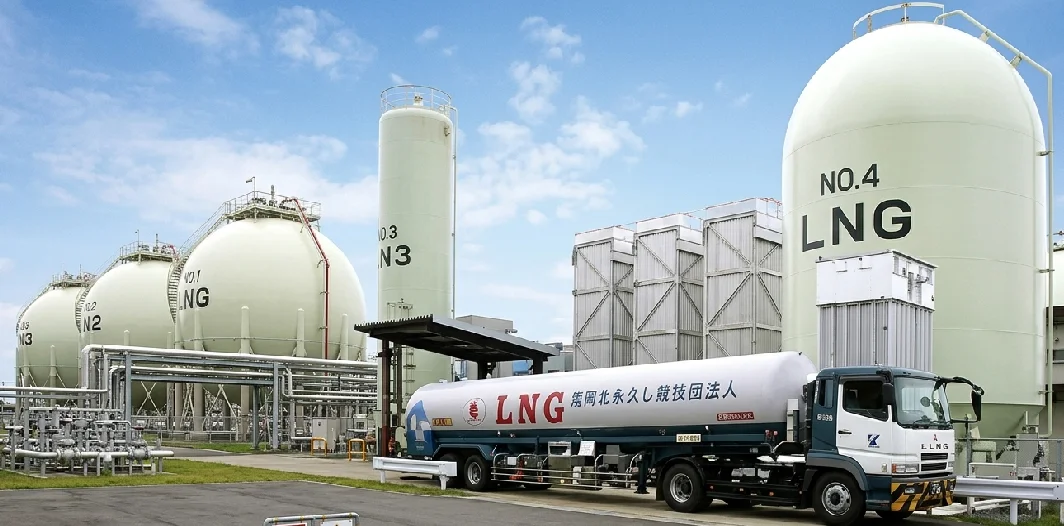
Liquefied Natural Gas or “LNG” for short, is a natural gas cooled to roughly -267° F at normal air pressure. It is odorless, non-toxic, non-corrosive and less dense than water.
Natural gas is the cleanest burning fossil fuel, and produces less emissions and pollutants than either coal or oil. As a liquid, LNG is not explosive, LNG vapor will only explode if it is kept an enclosed space under pressure.
The conversion of natural gas into liquid is called liquefaction and is achieved through refrigeration. Liquefaction reduces the volume by approximately 600 times, making it more economical to transport between continents in specially designed ships. LNG is converted back to gas by passing the liquid through vaporizers that warm it.
Natural gas is composed primarily of methane (typically, at least 90%), but may also contain ethane, propane and heavier hydrocarbons. Small quantities of nitrogen, oxygen, carbon dioxide, sulphur compounds, and water may also be found in “pipeline” natural gas. The liquefaction process removes the oxygen, carbon dioxide, sulphur compounds, and water. The process can also be designed to purify the LNG to almost 100% methane.